Introduction
The global insurance landscape is undergoing unprecedented changes as climate-related disasters become more frequent and severe. From wildfires and floods to hurricanes and droughts, the economic cost of natural disasters has surged. These events have forced insurers to reassess how they price risk.
As a result, insurance premiums are rising globally, reflecting the growing costs of climate adaptation, risk modeling, and payouts. Climate change is not only an environmental crisis—it’s an insurance and financial one as well.
1. Rising Costs from Extreme Weather Events
Over the last decade, insurers have faced a sharp increase in climate-related claims. According to Swiss Re and Munich Re reports, global insured losses from natural catastrophes have exceeded $100 billion annually in recent years.
Wildfires in North America, floods in Europe, and typhoons in Asia have tested the resilience of both private and public insurers.
These rising claim costs lead insurers to increase premiums, particularly in high-risk regions where weather events are becoming more destructive and unpredictable.
2. The Shifting Geography of Risk
Climate change is redrawing the world’s insurance maps.
-
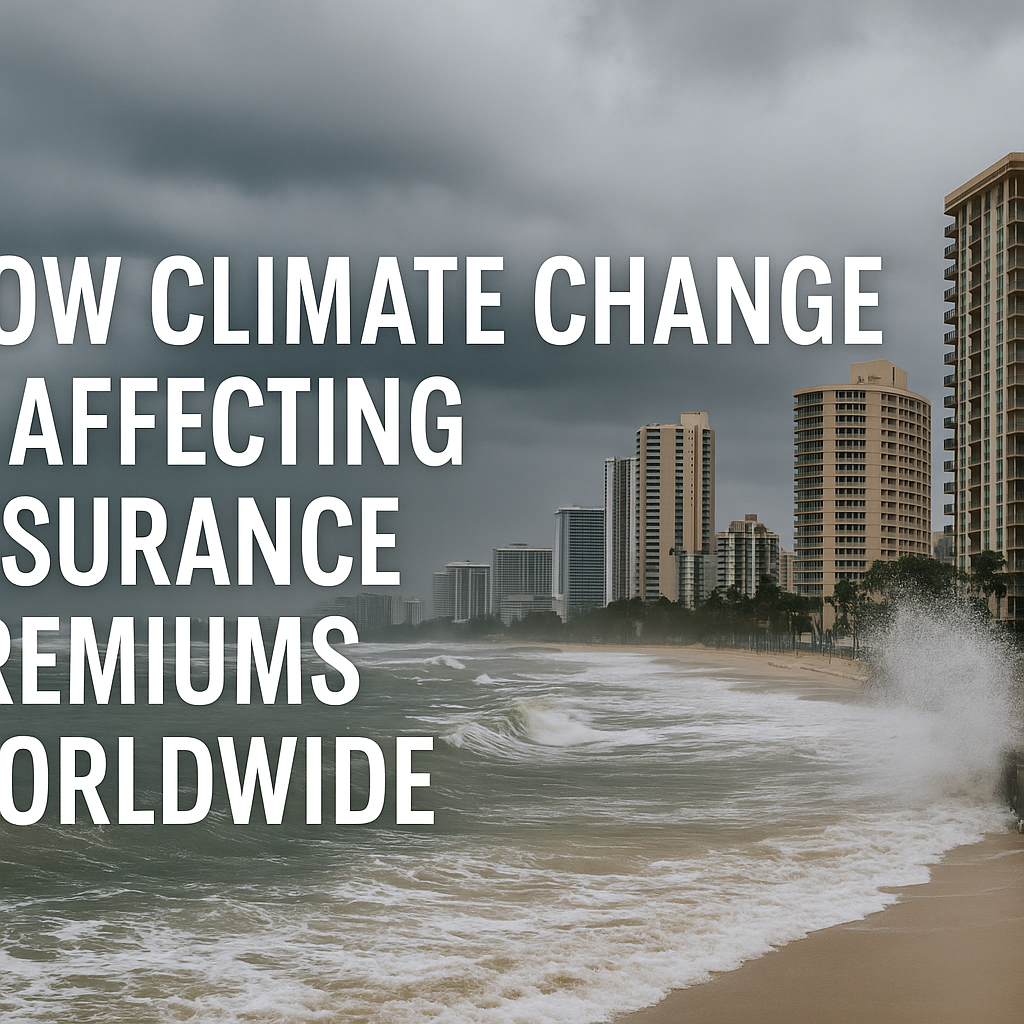
Coastal Areas: Rising sea levels and storm surges are making flood insurance more expensive or even unavailable in certain coastal zones.
-
Dry Regions: Drought-prone areas are seeing higher agricultural and property premiums.
-
Urban Centers: Cities with poor drainage systems face elevated flood risk, prompting insurers to revise pricing models.
In countries like the United States, Australia, and parts of Southeast Asia, entire neighborhoods are being reclassified as “high-risk zones,” forcing homeowners to either pay significantly more or lose access to coverage altogether.
3. Reinsurance and Global Market Ripple Effects
Insurance doesn’t operate in isolation. Reinsurers—companies that provide insurance for insurers—are also feeling the strain. As reinsurance costs climb, these expenses trickle down to primary insurers and eventually to consumers.
For example, after the devastating wildfires in California and floods in Europe, reinsurers raised their rates by as much as 30–40%. This cascading effect has made it difficult for smaller insurers to remain profitable without increasing customer premiums.
4. Climate Modeling and Predictive Analytics
To manage uncertainty, insurers are investing heavily in climate modeling and AI-driven predictive analytics.
By using satellite data, temperature trends, and advanced simulations, insurers can forecast future risks with greater accuracy.
While this technology improves preparedness, it also reveals uncomfortable truths: climate risks are rising faster than anticipated. These insights drive insurers to adjust their premium structures dynamically, resulting in periodic rate increases as new data emerges.
5. Regional Impacts and Disparities
The impact of climate change on insurance premiums varies globally:
-
North America & Europe: Property insurance costs are soaring, especially for flood and wildfire-prone zones.
-
Asia-Pacific: Developing countries face challenges with underinsurance and low resilience. Governments often intervene to subsidize premiums.
-
Africa & Latin America: Microinsurance and government-backed schemes are helping rural communities cope with agricultural losses due to drought or storms.
These disparities highlight the widening protection gap—many vulnerable populations remain uninsured or underinsured due to affordability issues.
6. Government Response and Regulation
Governments worldwide are stepping in to stabilize the market. Some have introduced public-private insurance partnerships or disaster relief funds to prevent mass uninsured populations.
For instance, the U.K.’s “Flood Re” program and the U.S. National Flood Insurance Program (NFIP) are designed to provide affordable coverage for high-risk properties.
However, such interventions are only short-term fixes. In the long run, the focus must shift toward climate adaptation, better infrastructure, and sustainable land-use planning.
7. The Path Toward Climate-Resilient Insurance
Insurers are evolving from passive risk managers to active climate partners.
They’re investing in sustainability-linked policies, promoting green building practices, and offering premium discounts for eco-friendly behavior.
By aligning financial incentives with climate action, the insurance industry can play a pivotal role in global resilience.
Conclusion
Climate change has fundamentally reshaped the economics of insurance. Premiums are rising not out of greed, but necessity—reflecting the escalating risks in our changing world.
The solution lies in innovation: using data, technology, and collaboration to build a fairer, climate-resilient insurance system.
In this new era, the question is no longer if climate change affects insurance—but how quickly the industry can adapt to protect both people and the planet.
